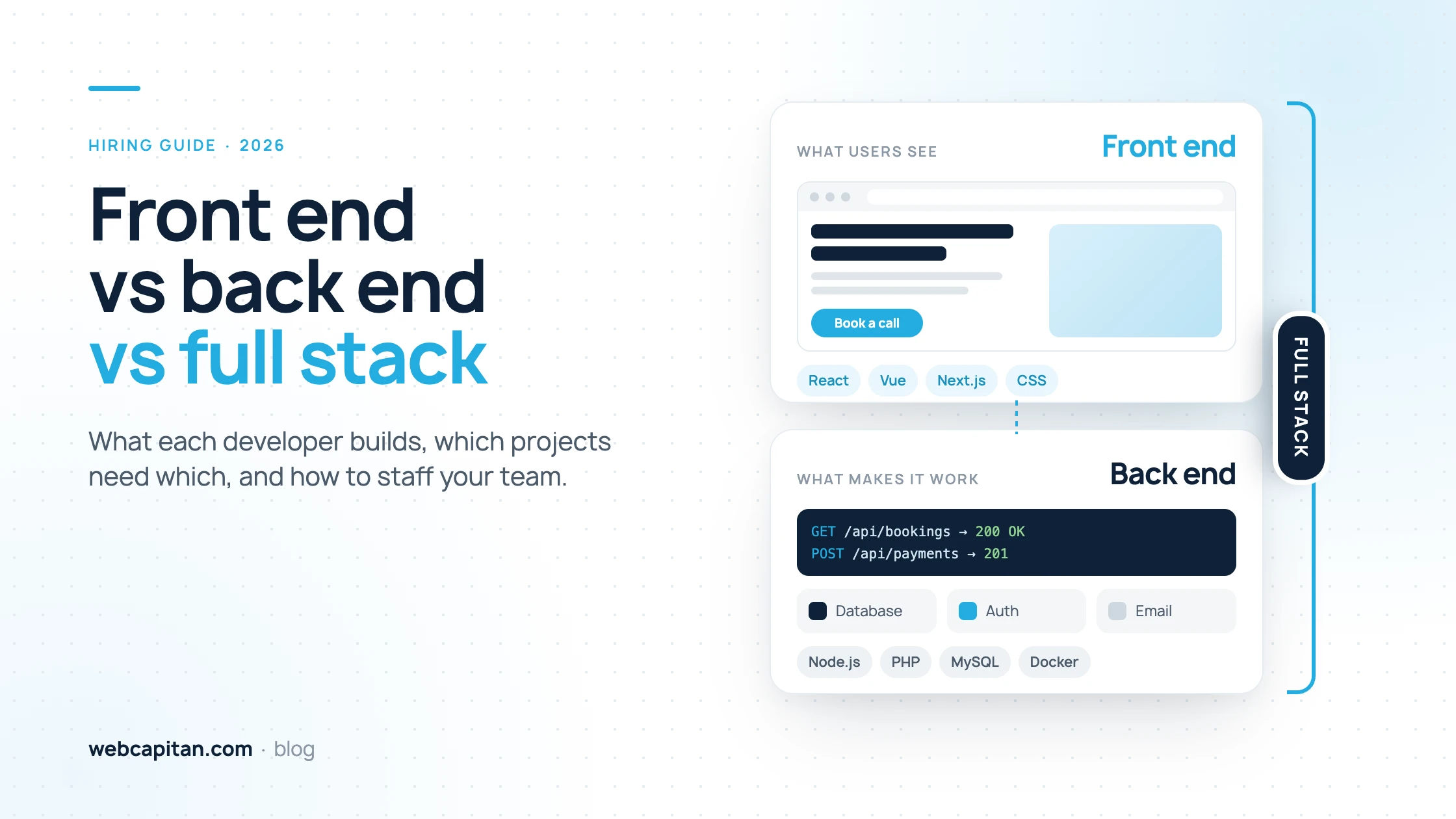
A front-end developer builds the part of a website people see and click, a back-end developer builds the server, database and logic behind it, and a full-stack developer can do both. A brochure or WordPress site usually needs front-end skills plus light back-end work, while e-commerce, web apps and mobile app back ends need serious back-end work and, as they grow, separate specialists.
This guide explains the three roles in plain language, shows which projects need which, compares the team shapes you can hire and ends with a short checklist. It is written for business owners and product managers, not for developers.
What front-end, back-end and full-stack developers do
The front end is everything that runs in the visitor's browser, the back end is everything that runs on the server, and full stack means one person working on both.
Take an online booking page for a dental clinic. The page layout, the calendar you click, the form that highlights a missing phone number and the way it all fits on a phone screen are front end. Checking which slots are free, saving the booking in a database, sending the confirmation email and showing the booking to the clinic's staff are back end. A full-stack developer could build the whole feature alone.
Front-end developer
Turns a design into working pages and interface components. Typical tasks:
- Building responsive layouts from a Figma design, from small phones to wide monitors.
- Menus, filters, sliders, multi-step forms and calculators.
- Page speed, accessibility and clean markup that search engines can read.
- Connecting the interface to a CMS or an API that the back end provides.
If you want the longer version, read what front-end development is.
Back-end developer
Builds the server side: data, business rules, security and integrations. Typical tasks:
- Designing the database and the API the front end talks to.
- User accounts, logins, roles and permissions.
- Payments, invoices, emails and notifications.
- Integrations with CRMs, ERPs, delivery services and other third-party systems.
- Hosting, backups, performance under load and protection against attacks.
Full-stack developer
Works across both layers and can take a feature from database to screen. Full-stack developers are most valuable on small and medium projects and early-stage products, where one person who sees the whole picture moves faster than two who hand work back and forth. On large projects they tend to be stronger on one side, so check which.
Front end vs back end vs full stack: comparison table
The quickest way to see the difference is side by side: what each role produces, the tools they use and the moment you need them.
| Role | What they build | Typical tools | When you need them |
|---|---|---|---|
| Front-end developer | Pages, interface components, interactions, responsive layouts | HTML, CSS, JavaScript, React, Vue, Next.js, WordPress themes | You have a design to turn into a site, or an existing product looks or feels wrong |
| Back-end developer | Databases, APIs, accounts, payments, integrations, server setup | Node.js, PHP, Python, MySQL, PostgreSQL, Redis, Docker | Your project stores user data, takes payments or connects to other systems |
| Full-stack developer | Complete features from database to screen | A mix of both, often JavaScript end to end (Node.js plus React or Next.js) | Small to mid-size projects, MVPs, ongoing support of a finished site |
Which projects need which role
The more your project stores, calculates and connects, the more back-end work it needs; the more it is about presentation and conversion, the more the front end matters.
- Brochure or landing site. Mostly front end. A contact form and analytics are the only server-side pieces. A front-end developer, or a full-stack developer, is enough. Front-end work for a landing page starts from $800.
- WordPress website. A WordPress developer is effectively full stack within one platform: a custom theme is front-end work, while custom post types, plugins and integrations are back-end PHP. WordPress websites start from $2,000.
- E-commerce store. Both sides are substantial. The front end decides how products, filters and checkout feel; the back end handles stock, prices, payments, shipping and order sync with accounting or a warehouse.
- Web application or SaaS. Back end first: data model, permissions, billing and an API. The interface is usually a separate React or Vue application. Expect separate front-end and back-end developers once the product has paying users. A web application interface alone starts from $8,000.
- Mobile app back end. Pure back-end work: an API, authentication, push notifications and an admin panel. The admin panel is the only front-end part, and a full-stack developer often builds it.
Team shapes: one full-stack developer, a pair or an agency team
There are three common ways to staff a web project, and the right one depends on its size, risk and how long it will live.
One full-stack developer
- Pros: lowest cost, no hand-offs, fast decisions, one person who knows the whole system.
- Cons: a single point of failure during holidays or illness, weaker in at least one area, no design, testing or project management unless you do it yourself.
- Fits: MVPs, internal tools, small sites and ongoing maintenance.
A front-end and back-end pair
- Pros: deeper skill on each side, work runs in parallel, the two review each other's assumptions.
- Cons: needs a clear API agreement and someone to coordinate; you still need a designer and testing.
- Fits: web apps and stores past the MVP stage, products with a steady roadmap.
An agency team
- Pros: designer, front-end and back-end developers, QA and a project manager in one contract; cover for absences; a fixed estimate and support after launch.
- Cons: higher price per hour than a solo freelancer, and some process overhead on very small jobs.
- Fits: business websites with deadlines, e-commerce, products where design and reliability matter.
As a rough guide to budget, hourly work with our team is $30–60, and a dedicated developer starts from $4,000 a month. For a breakdown of front-end pricing, see how much front-end development costs.
How agencies combine the roles
An agency matches the mix of roles to each stage of the project, rather than giving you one fixed person for everything.
A typical sequence looks like this. A designer produces the layouts and a clickable prototype; that is UI/UX design, a separate skill from coding. A back-end developer agrees the data model and API with the front-end developer before either starts building, so the two can work in parallel. The front-end developer builds the pages and components against that agreement. QA tests on real devices and browsers, and the project manager keeps scope, budget and your feedback in one place.
On smaller projects the same agency may assign one full-stack developer with a designer and QA around them. The roles still exist; one person simply covers two of them. At Webcapitan we work this way across web development and programming: front-end development services in React, Vue, Next.js and WordPress, and Node.js back-end development for APIs, accounts and integrations.
How to tell which one you need: a short checklist
Answer these questions about your project; each "yes" points to a role.
- Do you already have a back end, CMS or API and only need a new or faster interface? Front-end developer.
- Will users log in, pay, upload files or see data that changes? Back-end developer.
- Does the site need to sync with a CRM, ERP, warehouse or payment system? Back-end developer.
- Is it a small site, an MVP or a finished site that needs ongoing changes? Full-stack developer.
- Do you lack a finished design? Add a designer before any developer.
- Is there a fixed launch date, a large budget or revenue at stake? An agency team with QA and a project manager.
If you are unsure, describe what users should be able to do on the site. A good developer or agency will translate that list into roles and hours.
Frequently asked questions
Is a full-stack developer better than a front-end developer?
Not better, broader. A full-stack developer covers both sides, which suits small projects and MVPs. A dedicated front-end developer usually goes deeper on interface quality, speed and accessibility, which matters on larger sites and products.
Can a WordPress site be built by a front-end developer alone?
A simple one, yes, if a theme and standard plugins cover the features. Custom post types, custom plugins or integrations with other systems require PHP back-end work, so you need a WordPress developer who handles both.
What are front-end solutions?
The term usually means ready-built interface pieces or services: a component library, a design system, a theme or a complete interface for a web application. They cover what users see and are always connected to some back end for data.
Do I need a back-end developer for a static marketing site?
Usually not a dedicated one. Forms, analytics and a CMS can be set up by a front-end or full-stack developer. Bring in back-end work when you add accounts, payments, a booking system or integrations.
Conclusion
Front end is what people see, back end is what makes it work, and full stack is one person who handles both. Small sites and MVPs run well with a full-stack developer; stores, web apps and mobile app back ends need back-end depth and, as they grow, separate specialists with design and QA around them. If you are not sure which mix your project needs, send us a short brief and we will tell you which roles it needs and what they will cost.
About the author

CEO & Founder, Webcapitan
Roman Yashchuk founded Webcapitan in 2014 and leads the team of 22 designers and developers in Vinnytsia and London. He works hands-on in UI/UX design, WordPress and PHP/Laravel development, and writes about choosing platforms, costs and keeping websites fast and secure.
All articles by Roman Yashchuk