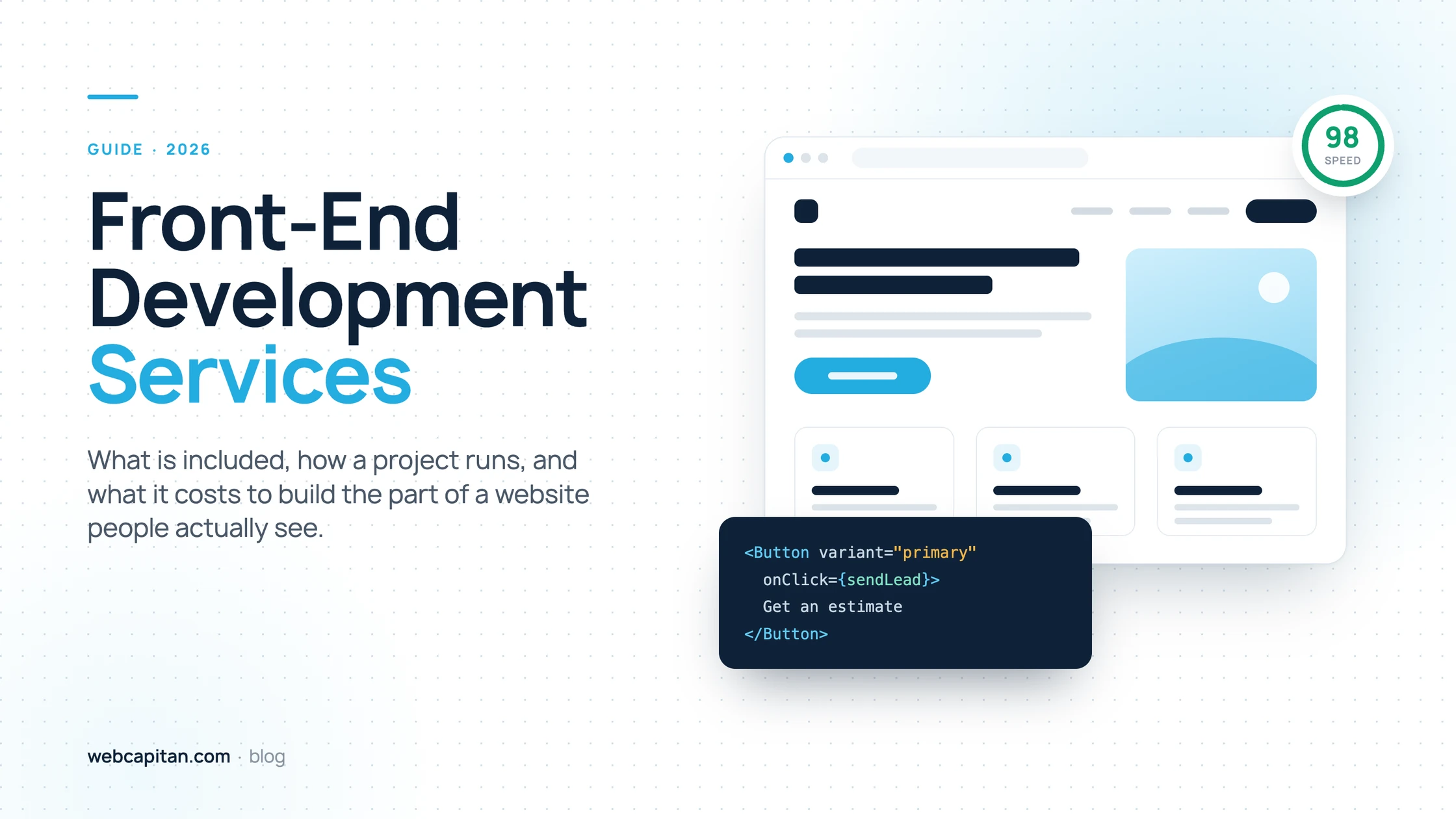
Front-end development services cover everything a visitor sees and touches on a website or web application: turning a design into working pages, making them fast and responsive on every screen, wiring them to a CMS or API and testing them on real devices. In 2026 a front-end project for a marketing website typically costs $4,000–9,000, a landing page $2,000–4,000 and the interface of a web application $8,000–15,000, with hourly rates from $30 in Eastern Europe to $150 in the US and UK.
This guide explains what you actually buy when you order front-end development, what the deliverables look like, which technologies are used and why, how a project runs week by week, what the pricing models are and how to check whether a team is any good. It is written for business owners and product managers who need to hire front-end developers, not for developers. If you first want the basics, read what front-end development is; this article picks up where that one ends.
What front-end development services include
A front-end service turns a design and a set of requirements into an interface that works: layouts, components, interactions, speed, accessibility and the connection to data. The list below is what a complete engagement covers; each item can also be bought on its own.
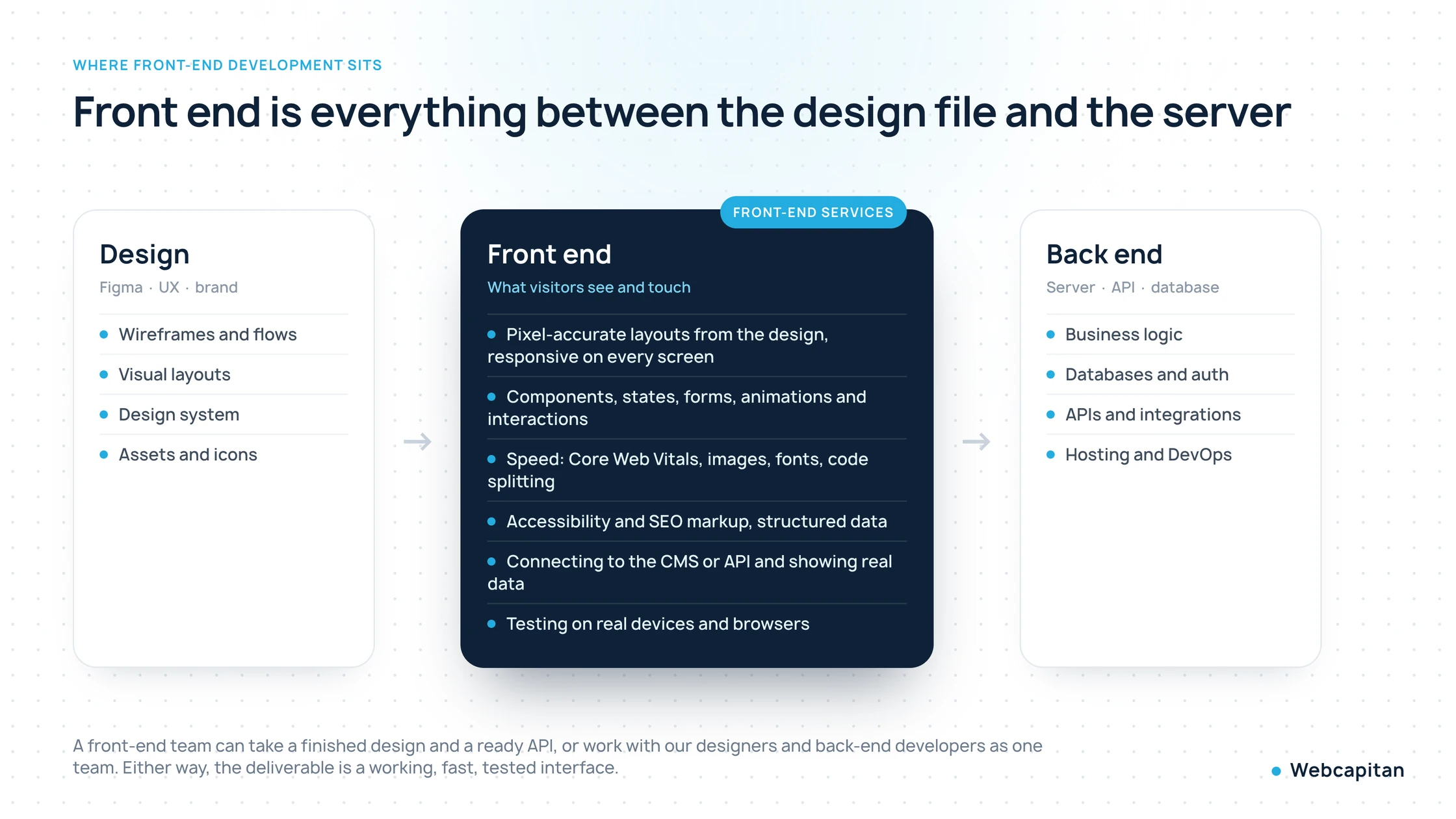
Front end is the layer between the design file and the server. A front-end team can start from your design and API or work alongside our designers and back-end developers.
- Design implementation. Pixel-accurate HTML, CSS and JavaScript from Figma or another design file, responsive from small phones to large monitors, including hover, focus and error states that designers often leave implicit.
- Component development. Reusable building blocks (navigation, cards, forms, modals, tables, sliders) in a framework such as React, so new pages are assembled rather than built from scratch.
- Interactions and animation. Menus, filters, calculators, multi-step forms, transitions and micro-animations, with reduced-motion versions for people who need them.
- Performance work. Core Web Vitals: fast first paint, no layout shifts, quick response to taps. Image and font optimisation, code splitting, caching and rendering strategy.
- Accessibility. Keyboard navigation, screen-reader labels, colour contrast and semantic markup to meet WCAG 2.2 AA, which is a legal requirement for many organisations in the EU and UK.
- SEO markup. Clean HTML structure, metadata, structured data and server-rendered content that search engines and AI assistants can read.
- Data integration. Connecting the interface to a CMS (WordPress, Sanity, Strapi), a REST or GraphQL API, forms, analytics and third-party widgets.
- Testing and browser support. Checks on real iOS and Android devices, current browsers, slow networks and different screen sizes; automated tests for critical components.
- Handover and support. Documentation, a component library your team can extend, and a support period after launch.
What you receive: typical deliverables
The result of a front-end project is working code plus the things that make it usable by your team afterwards. A proper handover includes:
- A Git repository with the source code and a clear README on how to run and build it.
- Built pages or a deployed application on your hosting, or a package your back-end team integrates.
- A component library or design-system implementation with documented props and variants.
- A performance report (Lighthouse or WebPageTest) and an accessibility check for the key pages.
- Browser and device test results, with any known limitations written down.
- Documentation for editors if the front end is connected to a CMS.
Technologies front-end teams use in 2026 and when each makes sense
Most business websites and applications are built with React and a framework around it such as Next.js; plain HTML, CSS and JavaScript remain right for small sites, and WordPress themes are still the most common front end for content sites. The choice should follow the project, not fashion.
| Technology | What it is | Use it when |
|---|---|---|
| HTML, CSS, JavaScript | The base of every front end | Small sites, landing pages, email templates, anything that must stay simple |
| React | Component library by Meta, the most used UI technology | Web applications, dashboards, interfaces with a lot of state |
| Next.js | React framework with server rendering, static pages and image optimisation | Marketing websites, e-commerce fronts, apps that must be fast and rank in search |
| Vue / Nuxt | Alternative to React with a similar model | Teams already using Vue; comparable results |
| TypeScript | Typed JavaScript | Any project larger than a landing page; fewer bugs, easier handover |
| WordPress theme | PHP templates rendering CMS content | Content-heavy sites edited by marketers; see our WordPress development services |
| Headless CMS + Next.js | CMS for editing, React front end for visitors | Speed and security with a familiar editor; multi-channel content |
| Progressive Web App | Website that installs and works offline | Mobile-first products without an app store; see PWA development |
Two practical notes. First, a "React website" built as a single-page application shows a blank page until its JavaScript loads, which hurts both visitors and search engines; for public websites insist on server rendering or static generation, which Next.js gives by default. Second, whatever the framework, ask for a design system: a set of typed, documented components. It is what makes the next page cost hours instead of days.
How a front-end project runs
A typical front-end engagement takes three to eight weeks for a website and two to four months for an application, in six stages. You should see working pages by the end of the second week, not a big reveal at the end.
- Discovery and audit (days 1–5). We review the design files, the API or CMS, browser and accessibility requirements, and analytics on the devices your visitors use. Output: a fixed estimate by page and component, and a schedule.
- Foundation (week 1–2). Project setup, design tokens (colours, type, spacing), the core components, and the first template deployed to a staging URL so everyone can click through early.
- Pages and features (weeks 2–6). Templates and components built in priority order, reviewed weekly against the design. Data is connected as soon as the API or CMS is available, so pages show real content early.
- Performance and accessibility pass. Images, fonts, script loading, caching and rendering are tuned until Core Web Vitals are green on a mid-range phone; keyboard and screen-reader checks are fixed.
- Testing and launch. Real-device testing, cross-browser fixes, forms and integrations verified end to end, then launch with monitoring in place.
- Handover and support. Documentation, a walkthrough for your developers or editors, a warranty period and optional ongoing support.
Front-end development pricing: models and 2026 ranges
Front-end work is priced in one of three ways: hourly, fixed price per project or a dedicated developer per month. Fixed price is the most common for websites; hourly and dedicated models suit products and ongoing work.
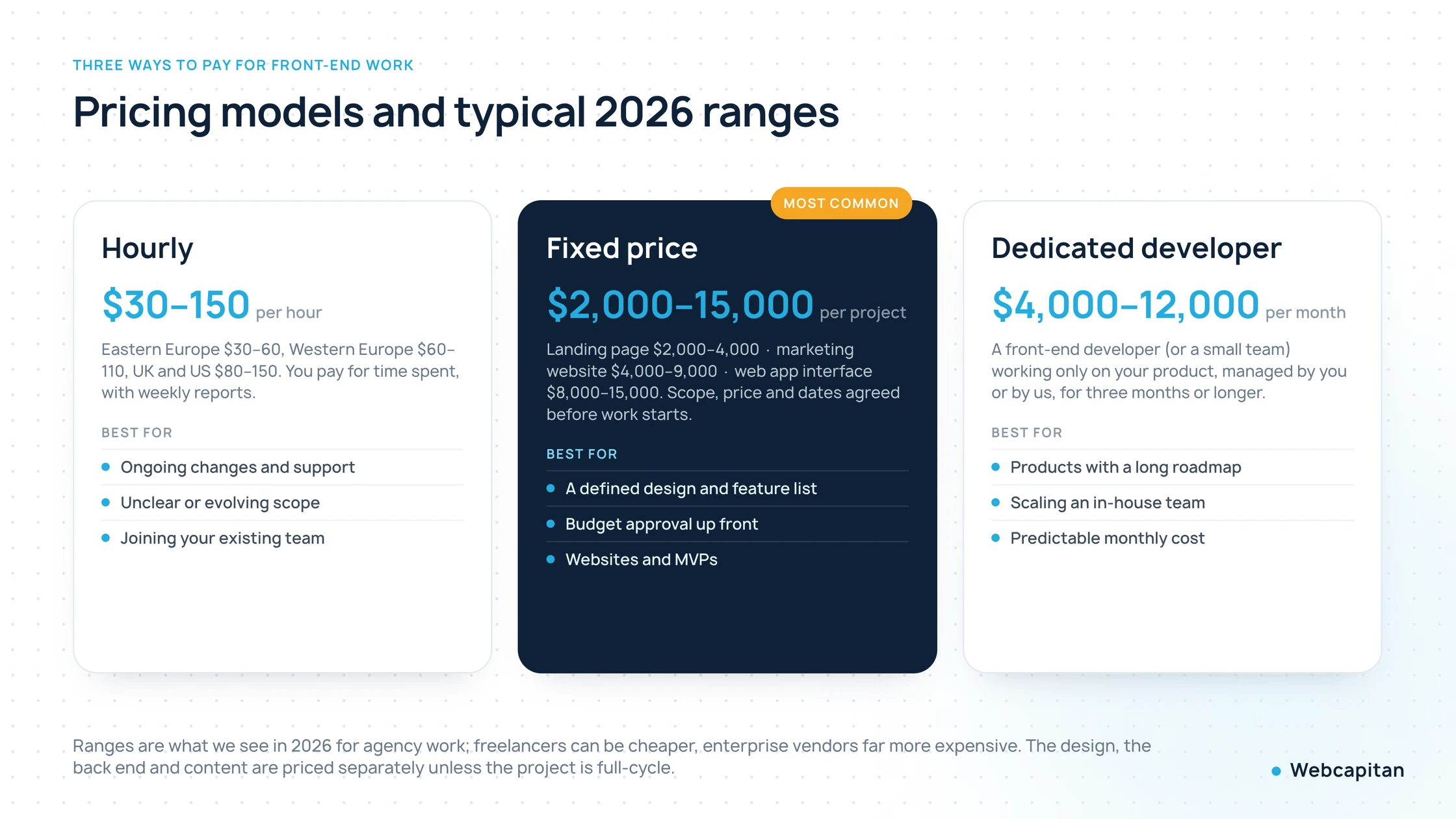
Typical agency ranges in 2026. Freelancers can be cheaper, enterprise vendors far more expensive.
Hourly rates by region
| Region | Agency rate per hour | Notes |
|---|---|---|
| Eastern Europe (Ukraine, Poland, Romania) | $30–60 | Senior developers, strong React and Next.js skills, EU time zone |
| Western Europe | $60–110 | Same time zone as UK and EU clients, higher overheads |
| UK and US | $80–150 | Local presence; often subcontracted to the regions above |
| South and South-East Asia | $20–40 | Lowest rates; quality and communication vary widely |
Fixed prices by project type
| Project | Typical price | Typical timeline |
|---|---|---|
| Landing page from a finished design | $2,000–4,000 | 1–2 weeks |
| Marketing website, 5–15 page templates, CMS connected | $4,000–9,000 | 3–8 weeks |
| E-commerce front end (headless store) | $8,000–15,000 | 6–12 weeks |
| Web application interface (dashboard, portal, SaaS) | $8,000–15,000 | 2–4 months |
| Design system or component library | $3,000–8,000 | 4–8 weeks |
| Performance and accessibility audit with fixes | $1,000–3,000 | 1–3 weeks |
What moves the price
- Number of unique templates and components, not the number of pages. Fifty pages on five templates cost less than ten pages on ten templates.
- Interaction complexity: filters, calculators, configurators, real-time data and animation add days each.
- Quality of the design hand-off. A complete Figma file with states and a mobile version saves 20–30% of development time.
- Integrations: every CMS, API, payment or analytics tool is a task, and undocumented APIs are the usual reason for overruns.
- Browser, device and accessibility requirements: WCAG AA compliance and support for old browsers add scope.
- Performance targets. Green Core Web Vitals on mobile is a deliverable, not a side effect; ask for it explicitly.
Front end only, or the whole project?
Hire front-end services alone when you already have a design and a back end or CMS, or when your own team lacks front-end capacity. Hire a full-cycle team when the project starts from a brief, because the biggest delays in front-end work come from unfinished designs and unready APIs, and one accountable team removes that hand-off. At Webcapitan both options exist: our front-end developers join existing teams, and our UI/UX designers and back-end developers cover the rest when you need it.
How to evaluate a front-end development team
Judge a front-end team by live sites, not slides: open three of their recent websites on your phone and run them through PageSpeed Insights. Then ask the questions below; a good team answers all of them without hesitation.
- Can we see the Core Web Vitals of your last three launches? Green mobile scores on real projects are the single best proof of competence.
- How do you render public pages? The answer for a website should include server rendering or static generation, not "it's a React app".
- How do you handle accessibility? Expect keyboard testing, screen-reader checks and a named standard (WCAG 2.2 AA).
- What do we own at the end? The repository, the components, the documentation and the deployment, without lock-in to the vendor's hosting.
- How do you work with our designers and back-end developers? Look for weekly demos, a staging URL from week one and a clear process for API contracts.
- Who exactly will do the work? Names, seniority and whether they stay for support. Subcontracting is common; hidden subcontracting is a red flag.
- What happens when the scope changes? A written change process with prices beats a vague "we'll see".
Front-end development services at Webcapitan
We have built front ends since 2014, first as WordPress themes and today mostly in React and Next.js, for clients in the UK, EU, US and Australia. Our own website is the proof we point to: it moved from WordPress to a Next.js front end in September 2026, keeps every old URL, and loads its home page with an 18 KB HTML document and a Largest Contentful Paint of about 1.9 seconds on a throttled 4G connection. What you get from us:
- React and Next.js front ends from your Figma design or from our designers, with a documented component library.
- WordPress themes and headless WordPress front ends when the site is content-driven.
- Progressive web apps and interfaces for web applications, connected to your API.
- Performance and accessibility audits with fixes for existing sites.
- Fixed estimates for websites, hourly or dedicated developers for products, with a staging URL from the first week.
Scope, prices and timelines are on our front-end development services page. See framework development and the wider web development and programming services for details, or look at recent work in our case studies.
Frequently asked questions
What is included in front-end development services?
Turning designs into responsive pages and components, adding interactions, making the site fast and accessible, connecting it to a CMS or API, testing on real browsers and devices, and handing over documented code. Design and back-end development are separate services unless the project is full-cycle.
How much does front-end development cost?
In 2026, $2,000–4,000 for a landing page, $4,000–9,000 for a marketing website and $8,000–15,000 for a web application interface at agency rates, or $30–150 per hour depending on region. The number of unique templates, interactions and integrations drives the price more than the page count.
How long does front-end development take?
One to two weeks for a landing page, three to eight weeks for a website and two to four months for an application. Finished designs and a ready API are the two things that keep a project on schedule.
Should I hire a freelancer or an agency for front-end work?
A freelancer is fine for a landing page or a small site with a finished design. For anything with integrations, deadlines or a long life, an agency gives you a team that covers absences, a review process and support after launch.
Is front-end development the same as web design?
No. Web design produces the layouts and visual system, usually in Figma; front-end development turns them into working code. Some agencies, including ours, offer both, but they are different skills and different stages of a project.
Conclusion
Front-end development services are where a design becomes the website your customers use, and where speed, accessibility and search visibility are won or lost. Buy them with a clear design, a ready data source and explicit performance targets, choose the pricing model that fits the scope, and judge teams by the sites they have shipped. If you want an estimate for your project, send us the design or a short brief and you will get a fixed quote broken down by page and component.
About the author

CEO & Founder, Webcapitan
Roman Yashchuk founded Webcapitan in 2014 and leads the team of 22 designers and developers in Vinnytsia and London. He works hands-on in UI/UX design, WordPress and PHP/Laravel development, and writes about choosing platforms, costs and keeping websites fast and secure.
All articles by Roman Yashchuk