Node.js and Next.js Development Services
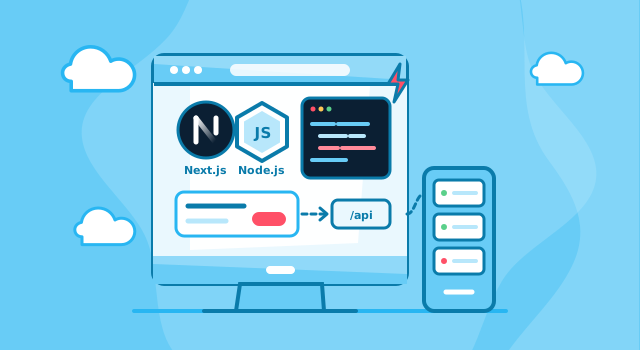
Node.js and Next.js development services are for businesses that need a website or web application that is fast, secure and built to grow: marketing sites that must load instantly and rank well, customer portals, SaaS products, dashboards and APIs. Next.js renders pages on the server and ships ready HTML to visitors, Node.js runs the back end and integrations in the same language, and the result is one modern JavaScript stack that a single team can build and maintain.
Webcapitan builds on this stack every day. Our own website, webcapitan.com, moved from WordPress to Next.js with a Node.js API in September 2026: every old URL was kept, the home page HTML is 18 KB, and the page shows its content in under two seconds on a throttled mobile connection. We offer the same approach to clients in the UK, EU, US and Australia, from a single landing page to a full web application.
Read the full overview
What we build with Node.js and Next.js
- Marketing and corporate websites on Next.js. Static or server-rendered pages, image and font optimisation, structured data and metadata built in, connected to a headless CMS or to a custom admin panel so your team edits content without a developer.
- Web applications and SaaS products. User accounts, roles, dashboards, billing, real-time data and complex forms with a React front end and a Node.js back end.
- Headless e-commerce fronts. Next.js storefronts for Shopify, WooCommerce, Medusa or a custom catalogue, with fast product pages and a checkout that converts.
- Node.js APIs and back ends. REST and GraphQL APIs with Express or NestJS, PostgreSQL or MySQL, authentication, file storage, email and queues.
- Integrations and automation. CRM, payment, ERP, marketing and analytics tools connected through APIs and webhooks; internal tools that replace spreadsheets.
- Migrations to Next.js. Moving from WordPress, another CMS or a legacy React app while preserving URLs, content and rankings.
- Performance rescue. Auditing and fixing slow React or Next.js projects: rendering strategy, bundle size, caching, Core Web Vitals.
Why Next.js for a business website
Next.js is the most widely used React framework because it solves the problems that a plain React app has on a public website. Pages are generated on the server or at build time, so visitors and search engines receive complete HTML instead of a blank page waiting for JavaScript. Images, fonts and scripts are optimised automatically, routes and metadata are part of the framework, and content can be refreshed on publish without rebuilding the whole site. For a business this means faster pages, better Core Web Vitals, cleaner SEO and a smaller attack surface: there is no admin login on the public site and no plugin layer to keep patched.
WordPress remains the right tool when a marketing team needs to rearrange pages every week without a developer; we build on both and will tell you which one fits. Read our comparison of WordPress vs a custom CMS, or the story of our own move away from a hacked WordPress site.
Why Node.js for the back end
Node.js lets the same team write the front end and the back end in one language, which keeps projects smaller and hand-offs fewer. It handles many simultaneous connections well, so it fits APIs, real-time features and integrations, and it has the largest package ecosystem of any platform. We use Express or NestJS for services, PostgreSQL or MySQL for data, Redis for caching and queues, and TypeScript across the stack for fewer bugs and an easier handover to your own developers later.
Our stack
| Layer | What we use | Why |
|---|---|---|
| Front end | Next.js (App Router), React, TypeScript | Server rendering, static pages, image and metadata handling out of the box |
| Back end | Node.js with Express or NestJS | Fast APIs, one language across the project, huge ecosystem |
| Data | PostgreSQL, MySQL, Redis | Reliable relational data, caching and background jobs |
| Content | Headless CMS (Sanity, Strapi, headless WordPress) or a custom admin panel | Editors keep a familiar interface; the public site stays static and fast |
| Hosting | Vercel, a Node server behind Nginx or Apache, Docker | Matches your budget and compliance needs; no vendor lock-in |
| Quality | Git, staging environments, automated tests, Lighthouse checks | Every change is reviewed and measured before it reaches visitors |
How a Node.js and Next.js project runs
- Discovery and architecture (week 1). Goals, content model, integrations and hosting are agreed; you receive a fixed estimate by page and feature and a schedule.
- Design (weeks 1–3). Wireframes and visual design in Figma for desktop and mobile, or we work from your existing design system.
- Foundation (week 2–3). Repository, design tokens, core components, the API skeleton and a staging URL you can open from the first sprint.
- Build (weeks 3–8). Pages, features and integrations delivered in weekly increments with demos; real content connected as soon as the CMS or API is ready.
- Performance, SEO and security pass. Core Web Vitals green on a mid-range phone, structured data and redirects verified, security headers and rate limits in place.
- Launch and support. Deployment with monitoring and backups, documentation, editor training, a warranty period and optional maintenance.
What it costs
A marketing website on Next.js with a CMS or admin panel typically costs from $4,000 and takes four to eight weeks. A web application starts at about $8,000 and runs from two to four months depending on scope. Hourly work is from $30 with our team, and a dedicated Node.js or Next.js developer is available from $4,000 a month. Every project starts with a fixed estimate broken down by feature, so you can cut or prioritise scope before work begins. For the wider picture, see what front-end development services include and cost.
Why Webcapitan
- Proof on our own domain: webcapitan.com runs on Next.js and a Node.js API that we built, host and measure.
- Design, front end and back end in one team since 2014, with 900+ websites delivered.
- Migration without SEO loss: we keep URLs, content and structured data, and we check every old address before launch.
- You own the code: repository, documentation and deployment are yours; any Node.js developer can continue the work.
- Honest platform advice: when WordPress or another tool is the better fit, we say so.
Related services: framework development, progressive web apps, API development and integration and headless WordPress integration. Ready to start? Tell us about your project and get a fixed estimate.

 United Kingdom
 United States