In the Craft CMS vs WordPress decision, WordPress is the better fit for most small and mid-sized businesses: it is free, every developer knows it, and almost any feature exists as a plugin. Craft CMS is the better fit when your content is highly structured, your editors want a clean, purpose-built admin, and you are happy to pay a small licence and rely on a developer for every new feature.
This comparison is written for business owners and marketing managers in the US and UK who have to choose a CMS for a new website or a rebuild, not for developers. It covers what each system is, what editing feels like day to day, flexibility, plugins, hosting and running costs, security, SEO and who should pick which. If you are also weighing a fully bespoke system, read our comparison of WordPress vs a custom CMS as well.
Craft CMS vs WordPress at a glance
WordPress wins on cost of entry, choice of developers and ready-made features; Craft wins on content structure, a tidy editor and a smaller attack surface. The table sums up the differences that matter to a business.
| Factor | WordPress | Craft CMS |
|---|---|---|
| Licence | Free, open source (GPL) | Free Solo edition for one user; paid Team and Pro editions with an annual update fee |
| Who uses it | Over 40% of all websites | A niche share, popular with design-led agencies and publishers |
| Editing | Block editor, familiar to most marketers | Custom fields and entry types built for your content |
| Custom fields | Via plugins such as ACF, or custom code | Built in, including flexible Matrix blocks |
| Extensions | About 60,000 free plugins plus premium ones | A smaller plugin store, many plugins paid with yearly renewals |
| Front end | Themes or a custom theme; page builders available | Templates written from scratch by a developer (Twig) |
| Developers available | Very many, at every price level | Far fewer, mostly specialist agencies |
| Security | Core is solid; most risk comes from plugins | Smaller target, fewer plugins, still needs updates |
| SEO | Mature plugins (Yoast, Rank Math) | Paid or custom SEO tools (for example SEOmatic) |
| Best for | Most business sites, blogs, WooCommerce shops | Content-heavy, structured, design-led sites with a developer on hand |
What WordPress and Craft CMS are
Both are PHP content management systems you host yourself, but WordPress is a general-purpose platform with a huge ecosystem while Craft is a developer-focused framework for building a CMS around your exact content.
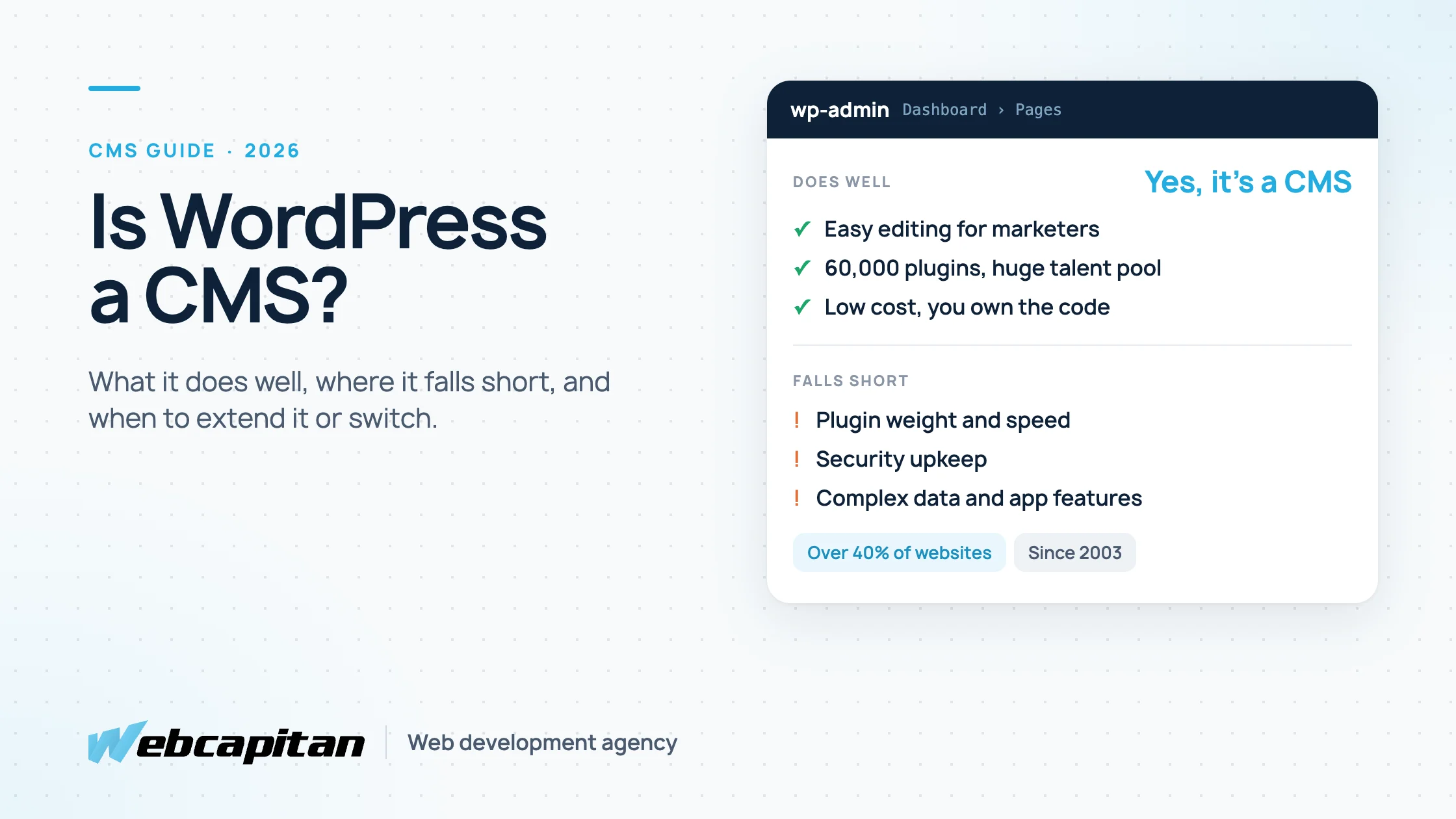
WordPress started as blogging software in 2003 and is now the most widely used CMS in the world, powering over 40% of all websites. It is free and open source. You get a working site out of the box, choose or commission a theme, and add features with plugins. Because so many people use it, finding a developer, a tutorial or an answer is easy.
Craft CMS is made by Pixel & Tonic, a US company, and was first released in 2013. It is built on the Yii PHP framework and uses Twig for templates. Craft ships with no front-end theme at all: a developer models your content (pages, products, team members, case studies) and writes the templates that display it. The current major version is Craft 5. Its licensing changed with that version: there is a free Solo edition for a single user, and paid Team and Pro editions for bigger teams.
Editing experience
Craft usually gives editors a cleaner, more predictable admin, while WordPress gives them more freedom and a more familiar interface.
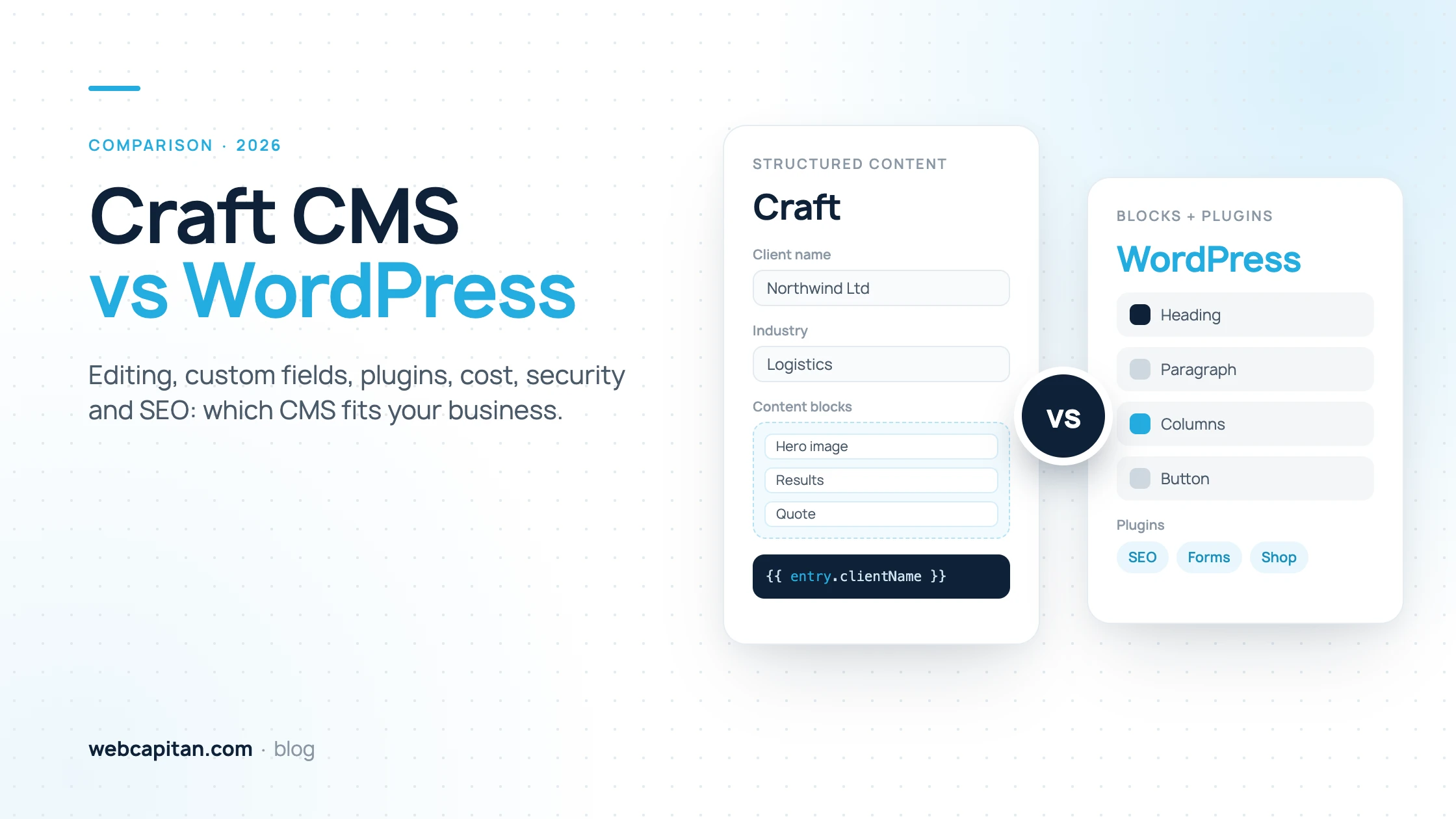
In Craft, every type of content gets its own form with exactly the fields it needs. A case study might have a client name, an industry, a hero image and a set of result blocks; nothing else appears on the screen. Editors cannot accidentally break the layout because the design lives in the templates, not in the editor. Live Preview shows changes side by side before publishing, and drafts, revisions and scheduled publishing are built in.
WordPress uses the block editor (Gutenberg). Editors build pages from blocks such as paragraphs, images, columns and buttons, and many teams add a page builder on top. This is flexible and well known to marketers, but it also makes it easy to drift from the brand: different fonts, spacing and button styles creep in over time. A well-built custom WordPress theme limits this by offering only the blocks and patterns your design needs.
- Choose Craft if several editors publish structured content and consistency matters more than freedom.
- Choose WordPress if your marketing team wants to build landing pages themselves and already knows the editor.
Flexibility and custom fields
Craft is built around custom fields and content relationships; WordPress can do the same, but usually through plugins or custom development.
Content modelling is Craft's strongest point. Developers define sections, entry types and fields in the admin, and the Matrix field lets editors stack repeatable content blocks in any order. Relations between entries (a service linked to its case studies, an author linked to articles) are first-class features. Multi-site and multiple languages are included in every edition, which suits brands with separate UK and US sites.
WordPress handles structured content with custom post types and a fields plugin such as Advanced Custom Fields, or with custom code. The result can be just as clean, but it depends on the developer. For multiple languages you need a plugin such as WPML or Polylang. Our custom WordPress development work is largely about this: building content structures and blocks that fit the business instead of forcing it into a generic theme.
Plugins vs building it yourself
WordPress lets you add most features in minutes with a plugin; with Craft, more features are built by a developer or bought from a smaller, mostly paid plugin store.
The WordPress plugin directory lists around 60,000 free plugins, and thousands of premium ones exist on top. Forms, bookings, memberships, e-commerce (WooCommerce), CRM integrations and SEO are all covered. The downside is quality: plugins vary widely, too many of them slow the site down, and each one is another thing to update.
Craft's plugin store is much smaller. Many of its plugins are well made and maintained, but a large share are paid and, like Craft itself, charge an annual fee for updates. Craft Commerce exists for online shops, but it is less common than WooCommerce. In practice a Craft site relies more on custom development, which gives a leaner, tailored result but costs more developer time for each new feature.
Hosting and cost
WordPress is cheaper to start and to staff; Craft adds licence and plugin fees and usually higher hourly rates, though its running costs are predictable.
Both run on ordinary PHP hosting with a MySQL database (Craft also supports PostgreSQL), so hosting costs are similar: from a few dollars a month for a small site to a few hundred for managed hosting on a busy one. Pixel & Tonic also sells its own managed hosting, Craft Cloud.
Licences are where they differ. WordPress itself is free. As of 2026, Craft's published pricing is roughly as follows:
- Solo: free, for a single admin user.
- Team: around $279 per project, for up to five users, then around $99 a year for updates.
- Pro: around $399 per project, for unlimited users and user groups, then around $99 a year for updates.
- Enterprise: custom pricing with single sign-on and dedicated support.
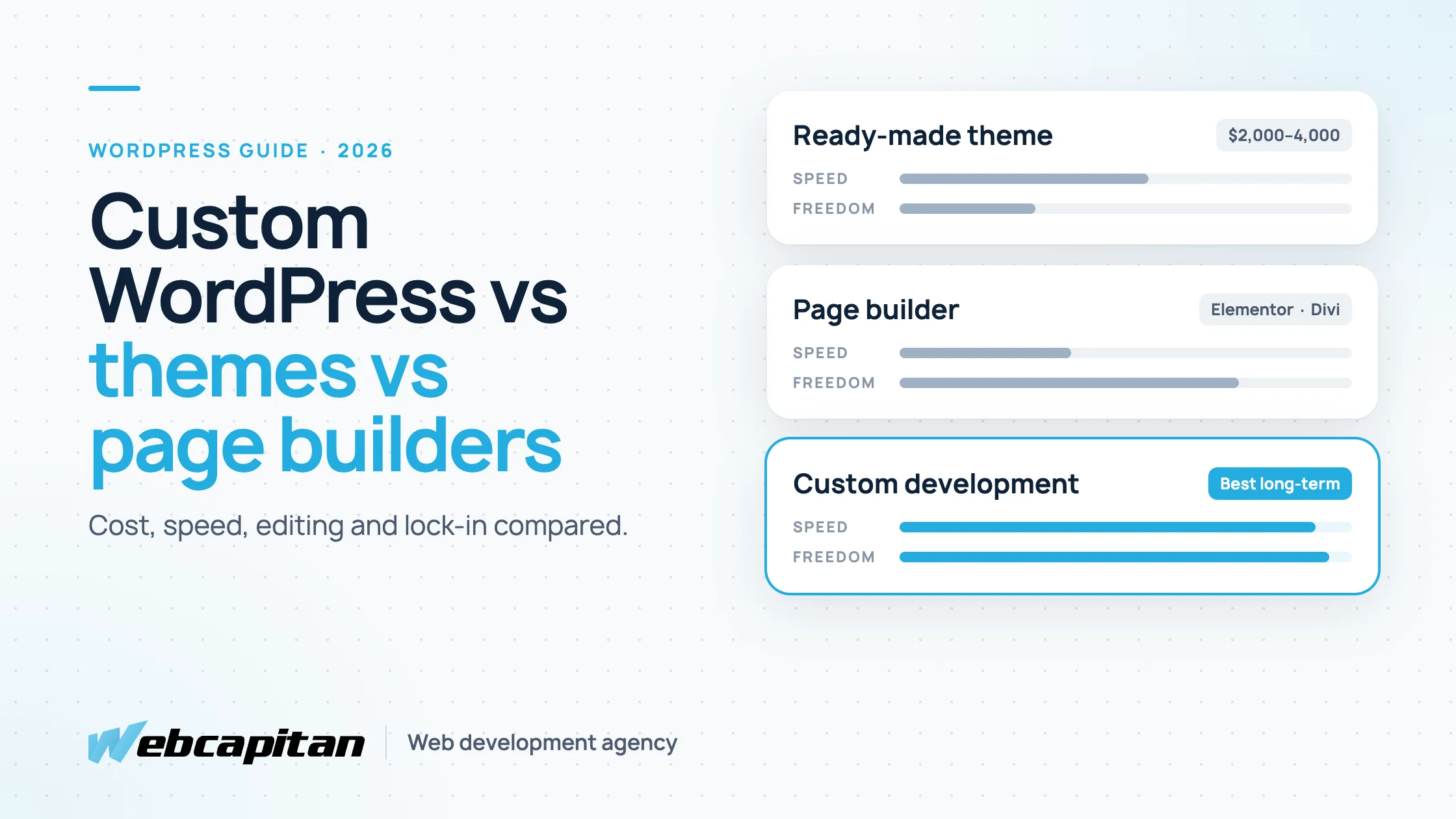
The licence itself is a small part of the budget. The bigger factors are development time and who can maintain the site later. WordPress developers are everywhere, so you can switch agencies or hire in-house easily. Craft specialists are fewer, which often means higher rates and more dependence on one team. For reference, our WordPress websites start from $2,000, and a fully custom CMS starts from $6,000; a Craft build typically sits closer to the custom end, because every template is written from scratch.
Security
Craft has a smaller attack surface and is targeted far less often, but a well-maintained WordPress site is safe too; the risk lies in neglect, not in the platform.
WordPress core is actively maintained and patched quickly. Most hacked WordPress sites are compromised through outdated or poorly written plugins and themes, or weak passwords. Because WordPress is so popular, automated attacks target it constantly.
Craft is attacked far less often simply because it is less common, and a typical Craft site uses only a handful of plugins. It still publishes security updates that you must apply, and an unmaintained Craft site is not safe either. Whichever you choose, budget for a support plan: regular updates, backups, uptime monitoring and a firewall.
SEO
Both can rank equally well; WordPress makes SEO easier for non-developers, while Craft gives developers full control over clean markup.
Search engines do not prefer one CMS over another. What matters is fast pages, clean HTML, correct titles and descriptions, structured data, sensible URLs and good content. WordPress has mature SEO plugins (Yoast, Rank Math) that let a marketer edit meta tags, generate sitemaps and set up redirects without a developer. The risk is a heavy theme or page builder that slows the site down.
Craft generates no front-end code of its own, so a good developer can produce very lean, fast pages. SEO fields, sitemaps and schema come from a plugin such as SEOmatic (paid) or are built in during development. Make sure your editors can change titles, descriptions and redirects themselves before the site goes live.
Who should pick which
Pick WordPress if you want a reliable site at a sensible price with a wide choice of developers; pick Craft if structured content and a polished editing experience justify a higher, developer-led budget.
WordPress is the better choice if:
- Budget matters. You want a professional site from around $2,000 and low running costs.
- You need features fast. Forms, bookings, memberships or a WooCommerce shop are available as plugins.
- Your team edits pages itself. Marketers know the block editor and can build landing pages without a developer.
- You want freedom to change suppliers. Any WordPress agency or freelancer can take over the site.
Craft CMS is the better choice if:
- Your content is structured and interlinked. Catalogues, case studies, publications, locations or events with many relationships.
- Several editors publish daily and you want a clean admin where nobody can break the design.
- You run several sites or languages from one installation.
- You have a long-term developer partner who knows Craft and will build new features as needed.
If neither fits, for example because you need complex business logic, client portals or unusual workflows, a custom CMS may be the right answer. See our CMS development services for how we approach those projects.
Frequently asked questions
Is Craft CMS better than WordPress?
Not in general. Craft is better for structured, content-heavy sites with a dedicated developer, and it offers a cleaner admin. WordPress is better for most business websites because it is cheaper, has far more plugins and developers, and is easier to hand over to another team.
Is Craft CMS free?
Partly. Since Craft 5 there is a free Solo edition for one admin user. Teams need Team or Pro, which in 2026 cost around $279 and $399 per project plus around $99 a year for updates. Many plugins are paid as well.
Can I migrate from WordPress to Craft CMS, or back?
Yes. Posts, pages, images and users can be moved with import tools and custom scripts, but the templates must be rebuilt and the content model redesigned, so treat it as a rebuild. Keep your existing URLs or set up redirects to protect search rankings.
Which is better for SEO, Craft or WordPress?
Neither has a built-in ranking advantage. WordPress makes on-page SEO easier for marketers through plugins like Yoast, while Craft lets developers produce very lean, fast pages. Speed, content and correct technical setup matter far more than the CMS.
Does Webcapitan build Craft CMS websites?
We build on WordPress, Next.js and Node.js, and custom CMS solutions. We do not offer Craft builds as a service, but we can review your requirements, advise whether Craft, WordPress or a custom system fits better, and migrate content between them.
Conclusion
For most businesses comparing Craft CMS vs WordPress, WordPress is the practical choice: lower cost, more features off the shelf and a huge pool of developers. Craft earns its place on design-led, content-heavy sites where structured content, a clean editor and multi-site support are worth a higher, developer-dependent budget. Decide based on your content, your editors and who will maintain the site in three years, not on the platform's popularity. If you want a second opinion on your shortlist, send us a short brief and we will recommend a platform and give you an estimate.
About the author

CEO & Founder, Webcapitan
Roman Yashchuk founded Webcapitan in 2014 and leads the team of 22 designers and developers in Vinnytsia and London. He works hands-on in UI/UX design, WordPress and PHP/Laravel development, and writes about choosing platforms, costs and keeping websites fast and secure.
All articles by Roman Yashchuk